
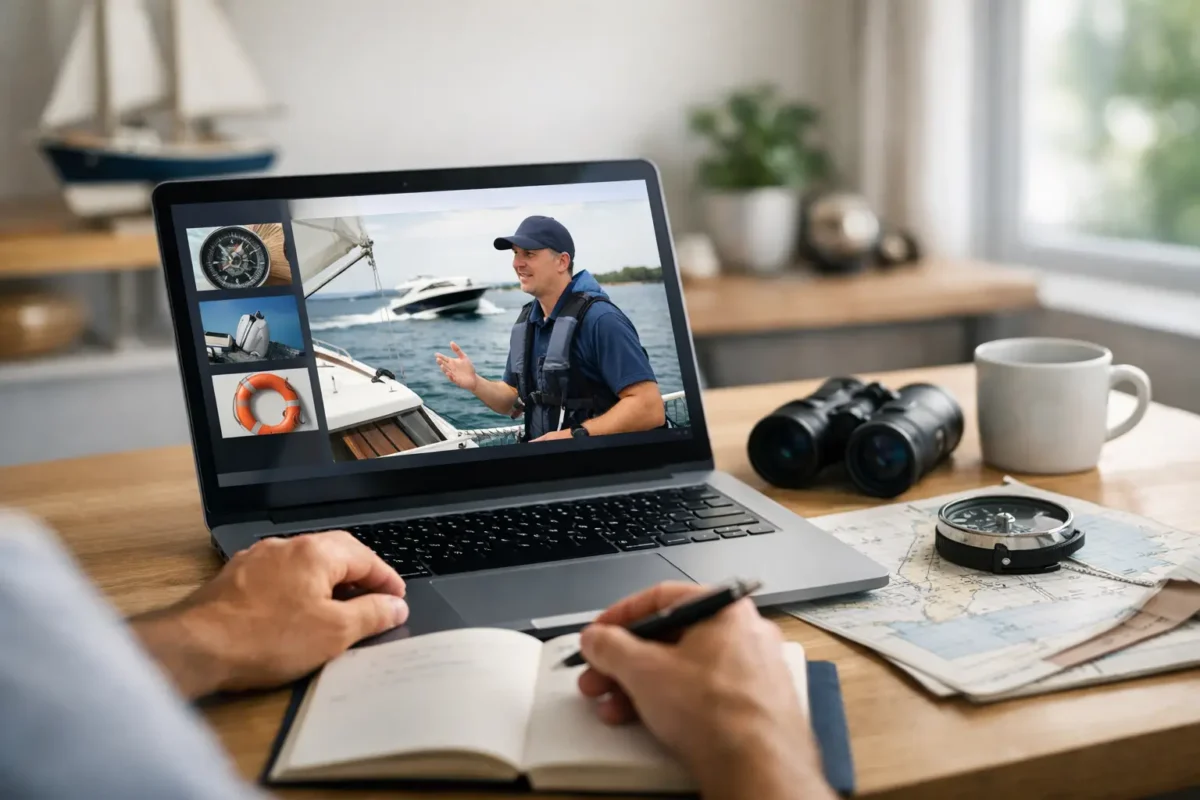
If you want the freedom to take the helm without spending weeks reshuffling your life around a classroom timetable, a PER course online is usually the first route worth considering. It gives you a practical way to prepare for one of Spain’s most popular recreational boating qualifications while keeping your routine intact. For many future skippers, that flexibility is what turns a vague idea into a real plan.
The appeal is obvious. You study from home, on the train, between meetings or after dinner, and you build momentum without putting normal life on hold. But flexibility alone is not enough. The real question is whether online learning gives you the confidence, knowledge and structure you need to pass the theory and move properly into life on the water.
What a PER course online actually gives you
The PER, or Patrón de Embarcaciones de Recreo, is the qualification many people choose when they want to move beyond casual sea trips and start navigating with more autonomy. It opens the door to handling larger recreational boats and planning more ambitious outings, which is exactly why it attracts people who are ready to stop being passengers and start making decisions at sea.
A PER course online focuses mainly on the theory side of the qualification. That means navigation rules, safety, meteorology, buoyage, charts and the core concepts you need before stepping into practical training. Done well, it is not just a bundle of notes uploaded to a platform. It should give you a clear progression, realistic exam preparation and access to tutors who know where students usually get stuck.
This matters because the PER syllabus is manageable, but it is not something to take lightly. If you choose a weak course, the convenience quickly wears off. You end up with scattered materials, unanswered questions and the feeling that you are revising alone. A good online format should do the opposite. It should make the path feel clearer, faster and more controlled.
Who suits a PER course online best
Online study is not only for people with packed calendars, although it certainly helps. It suits adults who are motivated by a clear goal and like the idea of progressing at their own pace. If you are balancing work, family life or travel, the format is often the difference between starting now and postponing it for another season.
It also works very well for people who already feel connected to the sea. Maybe you have spent years going out on friends’ boats, hiring skippered charters or enjoying coastal plans in places like Valencia, and now you want real independence. In that case, online learning fits naturally because the motivation is already there.
Where it can be less ideal is for students who need constant in-person pressure to keep moving. If you know you only revise when someone sets the rhythm for you each week, a classroom setting may feel easier. That does not mean online is the wrong choice, only that you should look for a provider with strong tutor support, live sessions or a clear study roadmap.
The real advantages of studying PER online
The biggest advantage is flexibility, but there is more to it than convenience. Studying online lets you revisit difficult topics as many times as you need. In a classroom, if a chartwork explanation goes past too quickly, that moment is gone. Online, you can repeat it until it clicks.
There is also a practical psychological benefit. Many students find boating theory easier to absorb in shorter sessions. Thirty focused minutes on lights and shapes, followed by a break, is often more effective than a long block when your attention is already fading. That rhythm suits adult learners particularly well.
Cost and logistics often improve too. You avoid regular travel, you can fit learning around your life, and you do not lose momentum because of one missed session. For anyone living outside a city centre or trying to make progress during a busy month, that matters.
Then there is the pace. Some people fly through the theory because they are used to technical content. Others need longer with navigation exercises or regulations. A PER course online gives room for both profiles, which is one of its strongest points.
Where online learning has limits
This is where honesty matters. A PER course online is not a shortcut to becoming a capable skipper overnight. It solves the theory delivery very well, but boating is still physical, situational and practical. You need to interpret conditions, stay calm, communicate clearly and make decisions when things are moving.
That is why the practical elements remain essential. The smartest students treat the online course as the foundation, not the whole journey. They use it to arrive at the practical training with sharper knowledge, better questions and more confidence.
There is also the issue of discipline. Without a timetable, even a very good course can sit untouched for weeks. Momentum matters. If you are serious about getting qualified, you need a realistic study routine and a target exam date that keeps the process alive.
How to choose the right PER course online
Not all providers deliver the same experience, and this is where many people make the wrong call. They look only at price and forget that support, clarity and operational experience behind the course can make a major difference.
Start with the materials. The platform should be easy to use, the content should be well structured and the explanations should feel practical rather than academic for the sake of it. The best courses teach with the exam in mind but never lose sight of real navigation.
Then look at tutor access. Can you ask questions and get useful answers, or are you basically buying a password and hoping for the best? A school with real activity on the water usually teaches differently because it understands what these concepts look like beyond the screen.
Practice tests are another key point. You need to work with exam-style questions early, not only at the end. This helps you spot weak areas before they become a problem. If chartwork or regulations are slowing you down, you want to know that soon.
Finally, consider the full pathway. A strong provider should be able to guide you from theory to practical training and onward into the wider boating world. That continuity is valuable. It means less friction, fewer surprises and a more natural transition from student to skipper.
Why local experience still matters with online training
It may sound odd to mention local knowledge when talking about online study, but it matters more than many people expect. Learning from a nautical school rooted in an active coastal environment brings a layer of realism that pure online-only businesses often lack.
A team working every day with training, boat handling, charters and marine administration tends to understand what future skippers actually need. The theory stops feeling abstract because it is connected to real boats, real clients and real conditions. That changes the quality of the learning experience.
For students around Valencia or those planning to complete practical sessions there, this becomes even more useful. You are not dealing with a faceless course provider. You are building knowledge with people who operate in the same marine world you want to enter. Alfa Náutica reflects that integrated approach particularly well, combining training, sea experience and nautical services in one place.
What to expect after the theory
Passing the theory is a milestone, not the finish line. The next stage is where everything starts to feel real. Practical sessions bring the rules, charts and safety principles into motion, and that is often when students realise why the theory needed to be taken seriously.
This is also the exciting part. The shift from reading about navigation to actually preparing a boat, interpreting conditions and moving with purpose on the water is what many people are chasing from day one. The qualification is valuable, yes, but so is the confidence that comes with it.
A good online start can make that transition far smoother. You arrive better prepared, less overwhelmed and more ready to absorb the practical side. That is where the online route proves its value most clearly.
Is a PER course online worth it?
For most adults looking for a realistic, flexible and efficient way into recreational boating, yes. A PER course online is often the smartest first step. It removes unnecessary barriers, fits around modern life and helps you start building nautical knowledge now rather than someday.
The trade-off is simple. You gain flexibility, but you need commitment. You gain convenience, but you still need quality instruction and proper practical training. Get that balance right and the online route is not a compromise at all. It is a very effective way to begin.
If the sea has been calling for a while, waiting for the perfect moment rarely helps. Start with the route that fits your life, build your knowledge properly, and let the next chapter happen where it should – out on the water.