If you are searching for an escuela náutica Valencia, you are probably not looking for theory alone. You want a qualification that gets you on the water, an experience that feels exciting from day one, and a team that makes the whole process clear instead of complicated. That matters, because not every school gives you the same route from first class to first real day at sea.
In Valencia, the difference is obvious the moment you step out of the classroom and into the marina. This is a city built for recreational boating – long seasons, practical sailing conditions, easy access to the coast and a strong nautical culture. So choosing a nautical school here should not just be about passing an exam. It should be about learning to move with confidence, building real judgement on the water and opening the door to a lifestyle you can actually enjoy.
What makes an escuela náutica Valencia worth your time
A good school teaches the syllabus. A great one helps you become a safer, calmer and more capable skipper. Those are not the same thing.
When you compare options, look beyond the headline price or the promise of fast-track courses. Speed can be useful, especially if you need a Licence, PNB or PER quickly, but convenience only works if the training still feels solid. You need instructors who know how to explain the rules clearly, practical sessions that do not feel rushed, and boats that are in regular use rather than there just for the brochure.
The strongest schools usually combine four things well: official training, practical sea time, operational experience and support after the course. That last part gets overlooked. Many people pass an exam and then realise they still have questions about qualifications, upgrades, radio certification, practices or paperwork. If a school can guide you through the whole nautical journey, the value is much higher.
That is why local experience counts. A team working daily in Valencia’s waters understands port access, coastal conditions, traffic, seasonality and the kind of situations students actually face when they start boating here.
The right course depends on what you want from the sea
Not everyone needs the same qualification, and this is where many people waste time or money. The best choice depends on whether you want occasional leisure boating, regular weekend trips, longer passages or a step-by-step route towards bigger challenges.
Licence, PNB or PER?
If your goal is simple and immediate – getting out on the water quickly for short recreational use – the Navigation Licence can be the cleanest first step. It is accessible, practical and ideal for people who want to start without overcomplicating things.
If you want more range and a more formal grounding, PNB can make sense. It gives structure and confidence, especially for those who are serious about learning but not yet ready to jump straight into PER.
For many students, though, PER is the turning point. It is often the qualification that changes boating from a one-off plan into a real personal freedom. It opens far more possibilities and suits people who want flexibility, progression and the feeling that the sea is now genuinely within reach.
When advanced qualifications are worth it
Patrón de Yate and Capitán de Yate are not for everybody, and that is fine. If your boating plans are local and occasional, going straight to advanced levels may be unnecessary. But if you see yourself making longer trips, taking bigger boats seriously or turning boating into a major part of your life, moving up becomes a natural next step.
The right school should help you decide honestly. Sometimes the best advice is not to push ahead too fast, but to gain experience first and step up when your confidence matches your ambition.
Why practical training matters more than many students expect
Passing the theory exam feels great. Then your first manoeuvre in a marina reminds you that boating is physical, spatial and very real.
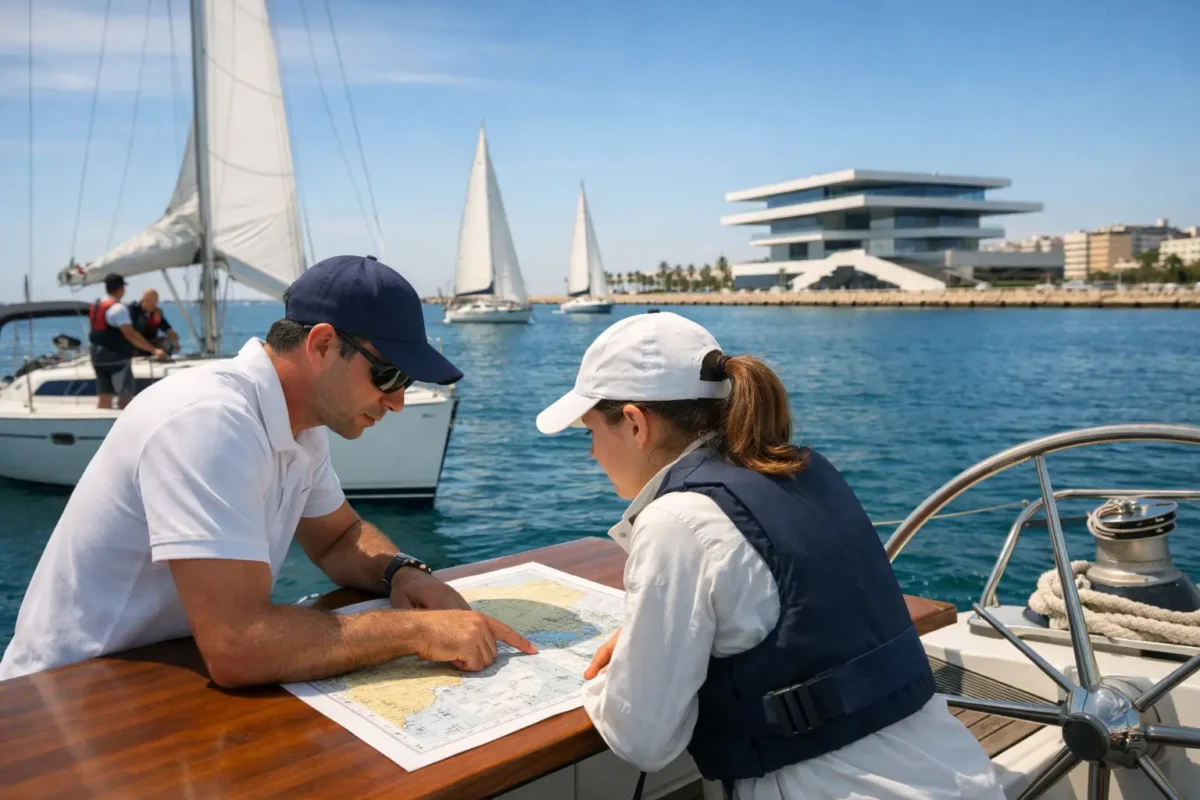
That is why practice is where confidence is built. Mooring, turning under pressure, reading wind and traffic, handling communication and understanding your boat’s reactions cannot be learned properly from slides alone. A school with an active fleet and real daily operation usually gives students a more grounded education because the sea is part of the business, not an afterthought.
In Valencia, this matters even more. Busy marinas, changing conditions and a lively recreational scene mean practical knowledge becomes useful immediately. Students learn faster when training feels connected to the environment where they will actually navigate.
A broad fleet also makes a difference. Training across well-maintained vessels gives a more realistic sense of what boating involves and helps remove that common fear of being “qualified on paper” but uncertain in practice.
A complete nautical service changes the experience
One of the smartest things a student can look for in an escuela náutica Valencia is whether the school only teaches, or whether it can support the full journey.
This is where an integrated nautical company stands out. If the same brand offers training, sea experiences, charter, skippered outings and administrative support, the path becomes much smoother. You can start with a day on the water, move into formal training, complete the right practices, and sort the paperwork without bouncing between separate providers.
That model is not just convenient. It reduces friction at every stage. It also means the team understands different kinds of customers – curious beginners, future skippers, holiday users, regular boaters and owners who need ongoing help.
For many people, that is the difference between “I’d like to do it one day” and “I’m actually starting now”. Alfa Náutica has built its reputation around exactly that kind of 360-degree nautical experience in Valencia, combining training, leisure and specialist support under one roof.
What to look for before you book
The best school for you is not always the one with the loudest claims. It is the one that fits your schedule, your level and your reason for getting qualified.
Look at how classes are delivered. Online or intensive options can be brilliant if you need flexibility, but only if the academic support is responsive and clear. Check whether the practical sessions are easy to schedule, whether the fleet seems active and professional, and whether the instructors come across as people who actually spend time on the water.
It is also worth paying attention to scale. Experience matters in boating because operations reveal quality. A company handling thousands of clients a year, multiple offices and a sizeable fleet has usually solved the practical details that smaller operators are still figuring out. That does not automatically mean better teaching, but it often means better organisation, more availability and fewer weak points.
At the same time, personal treatment still matters. You want efficiency, but not impersonality. The ideal school gives you both – energy, structure and a sense that your next step is obvious.
Valencia is not just a place to qualify – it is a place to use it
This is perhaps the biggest advantage of learning here. In some locations, people get their certificate and then struggle to turn it into a habit. In Valencia, the link between training and enjoyment is immediate.
You can learn, practise and then keep the momentum going through real boating experiences. That continuity matters because confidence grows through repetition. The more often you are near boats, around marinas and out on the water, the faster the nautical world starts to feel natural.
That is also why a school connected to experiences and charter can be so valuable. You are not just studying for a piece of paper. You are entering a lifestyle built around freedom, coastline, friends, weekends away and the simple satisfaction of taking command properly.
If that is what you want, choose a school that treats the qualification as the start of the story, not the finish line.
Escuela náutica Valencia: the smart choice is the one you will use
A qualification only has value if it moves you closer to the sea you want to enjoy. So ask practical questions. Will the course fit your routine? Will the training leave you calm at the helm? Will the school still be useful once the exam is over?
That is the real test. Not who promises the most, but who prepares you best for real navigation and makes the whole process feel clear, exciting and worth doing.
The sea off Valencia is not there to admire from the shore. Pick the right school, take the first step properly, and give yourself the freedom to use it.