
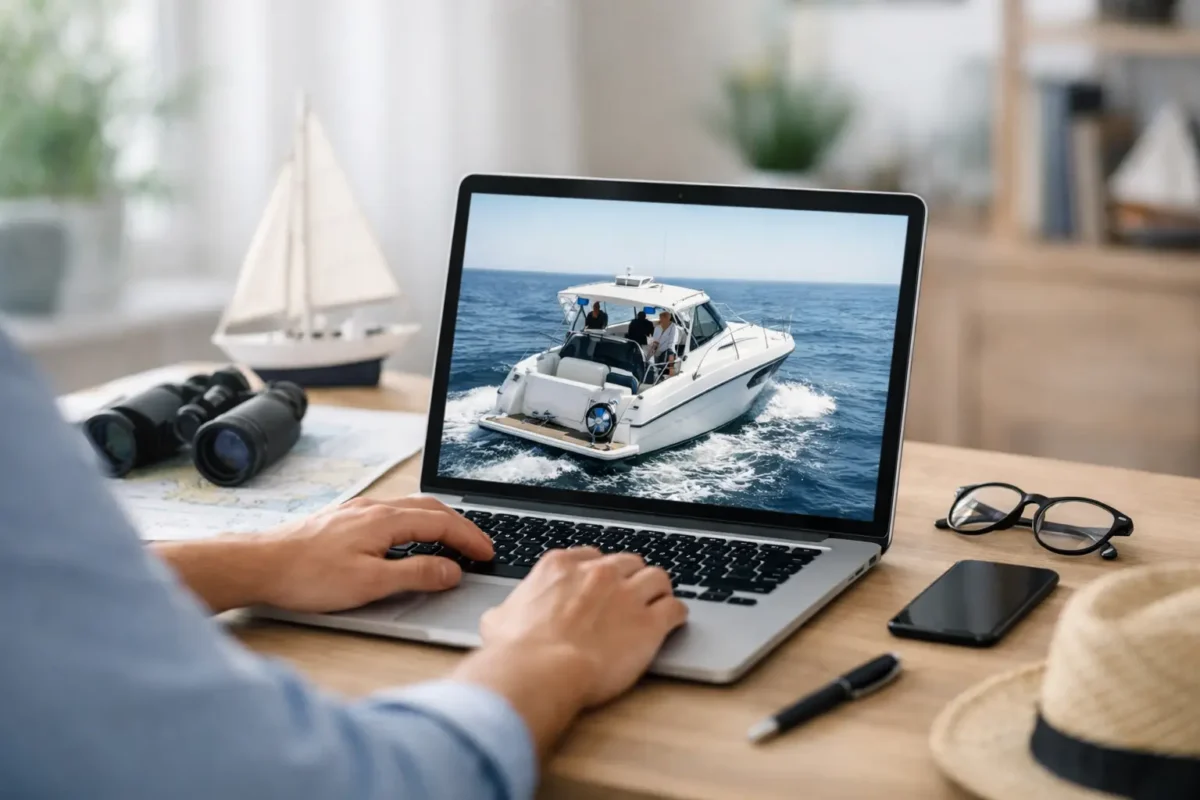
If your plan is to stop depending on friends, skippers or summer improvisation, learning how to get the PER online is usually the fastest route from passenger to person in command. It gives you a clear objective, real autonomy on the water and a qualification that opens the door to much more than an occasional day out at sea.
The appeal is obvious. You can study theory from home, fit lessons around work and keep moving without putting your life on hold. But there is a catch: online does not mean effortless. The people who get their PER smoothly are not always the ones with the most free time, but the ones who understand exactly what the process involves from day one.
How to get your PER online: what the process really looks like
The PER is the Spanish recreational boating license known as Patron of Recreational Boats. In practice, it is the qualification many future skippers aim for because it gives a strong balance between freedom and accessibility. It is far more versatile than the most basic licenses, but still realistic for adults with jobs, family commitments and limited study time.
When people ask how to get the PER online, they often imagine a fully digital process from start to finish. The reality is more mixed. The theory can be prepared online very comfortably, and for many students that is the part that changes everything. You can attend live virtual classes, watch recorded sessions, review test banks and build confidence at your own pace. But the qualification itself still includes mandatory practical elements and an official exam. So the smart approach is not to look for a shortcut. It is to look for a system that makes the whole route simpler.
What you need to get the PER
Before worrying about timetables or revision plans, it helps to know the parts you must complete. To obtain the PER in Spain, you generally need to pass the theoretical exam, complete the compulsory practical training and hold a valid medical certificate for nautical licenses. If you want the extension that allows sailing to the Balearic Islands and larger motor vessels, you will also need additional practices.
This is where many students lose time. They focus only on the online classroom and leave the practical sessions, paperwork and exam booking for later. Then everything becomes fragmented. A much better route is to treat the PER as one joined-up process: theory, exam, sea practice and administration all planned from the beginning.
For anyone based in or around Valencia, this matters even more. The easier it is to coordinate theory with local practical sessions and exam dates, the less likely you are to stall halfway through.
Why online study suits most future skippers
The biggest advantage of online learning is flexibility, but that word gets overused. What matters in real life is not flexibility as a concept. It is whether you can check navigation lights after dinner, watch a class on meteorology at the weekend and repeat chart work until it finally clicks.
For adult learners, that changes the game. You do not need to commute to a classroom several times a week. You do not need to learn at exactly the same rhythm as everyone else. And if one topic comes easily while another takes longer, you can redistribute your effort without feeling that the group has moved on without you.
There is also a confidence benefit. Many people come to the PER with enthusiasm for the sea but no academic appetite. They worry they have been away from exams too long. Studying online can reduce that pressure because it lets you absorb the theory in shorter, more manageable blocks. One focused hour, done consistently, is often more effective than a long session when you are already tired.
That said, online is not ideal for everyone. If you know you only study well under strict external pressure, a purely self-directed approach may not suit you. In those cases, the best online courses are the ones that still provide structure through live classes, tutor support and regular mock tests.
The theory exam: easier than people think, harder than people admit
The PER syllabus is perfectly achievable, but it deserves respect. You will cover navigation, safety, regulations, buoyage, lights, basic meteorology and radio-related knowledge. None of this is impossible. The challenge is that several topics are unfamiliar at first, especially if you have never spent time around boats.
The mistake is assuming that because it is a recreational license, the exam will be casual. It is not. You need proper preparation. At the same time, people often make it sound more intimidating than it is. With a solid online method, repeated test practice and a bit of discipline, most motivated students can arrive at the exam with real confidence.
A good rule is to avoid memorizing blindly. If you understand why a lateral mark means what it means, or why a specific rule applies in a crossing situation, recall becomes much easier under exam conditions. The sea does not reward vague learning, and neither does the test.
How long does it take?
This depends on your schedule, the exam calendar in your region and how quickly you book your practical training. Some students prepare in a few intense weeks. Others take two or three months and prefer a steadier pace. Neither route is automatically better.
If you work full time, the realistic question is not how fast you can finish, but how reliably you can keep going. A rushed plan that collapses after ten days is worse than a six-week plan you actually complete. For most people, the sweet spot is a structured period of theory study followed by the exam and practical sessions booked as close together as possible.
Momentum matters. The more space you leave between study, exam and practice, the easier it is to lose focus. When the process flows well, everything feels lighter.
Common mistakes when trying to get your PER online
The first is choosing only on price. Saving a little at the start can cost much more later if the course lacks proper tutor support, updated materials or enough exam practice. Cheap access to a platform is not the same as effective preparation.
The second is underestimating chart work and regulations. These are often the areas that students postpone because they seem technical. That is exactly why they should be tackled early.
The third is forgetting that the goal is not merely to pass. It is to become a skipper who feels in control. A course should prepare you for the exam, yes, but it should also help you step onto a boat with more judgment, more awareness and more calm.
Finally, many people delay the admin side. Medical certificate, enrollment, exam registration and practical bookings sound secondary until they become the reason your qualification is delayed.
Choosing the right school for your PER online
If you are comparing options, look beyond the headline claim that the course is online. Ask how the theory is delivered, how doubts are resolved, whether the materials are updated and how often students can practice mock exams. Then look at the practical side. Does the school also run the sea training? Can they help you coordinate dates? Do they have real operational experience, not just an online platform?
This is where a 360 approach makes a difference. A school that understands training, life on the water and the admin behind recreational boating can make the whole process feel much more simple. For students in Valencia, working with a team that knows the local rhythm of exams, practices and nautical life adds another layer of reassurance. Alfa Náutica, for example, has built that kind of joined-up experience around training, navigation and support services, which is exactly what many future skippers are looking for.
What happens after you pass
Passing the PER is not the end point. It is the moment the horizon gets wider. You can move from spectator to decision-maker, plan your own days at sea and start building real experience. If you continue with extra practice, sailing endorsements or larger ambitions later on, the PER becomes the foundation rather than the finish line.
That is why it pays to approach the course with the right mindset. Not as a bureaucratic box to tick, but as the start of a more independent way to enjoy the coast, the boat and the freedom that comes with knowing what you are doing.
If you are serious about the sea, learning how to get the PER online is less about sitting in front of a screen and more about taking your first proper step towards life as a skipper – with confidence, structure and the feeling that the next departure depends on you.