The first time you take the helm yourself in Spain, everything changes. The coast looks different, the day opens up, and the sea stops being something you watch from shore. If you are searching for a licence navigation course Spain, you are usually looking for one thing – a fast, legal and straightforward way to start enjoying the water with more freedom.
For many adults, this is the simplest entry point into recreational boating in Spain. It is practical, accessible and far less intimidating than people expect. But there is a catch: the name often creates confusion, especially for English-speaking residents, holiday-home owners and visitors trying to understand what they actually need.
What is a licence navigation course in Spain?
In Spain, the Licencia de Navegación is an official recreational boating qualification. It is designed for people who want to handle certain boats without committing to a long theory-heavy route. If your goal is to get on the water quickly and start building confidence, this is often the most direct path.
The course is shorter and more approachable than qualifications such as PNB or PER. That makes it attractive to people who want real autonomy but do not need wider cruising limits straight away. Couples who want weekend plans with more edge, groups of friends who are done relying on skippered trips, and sea lovers who want a proper first step usually start here.
What makes it so popular in Spain is simple: it removes friction. You do not need to spend months studying charts before you can enjoy a legal day out on the water. You complete the required training, understand the basics of safety and boat handling, and step into the boating world with a recognised qualification.
What does the Licencia de Navegación allow you to do?
This is where expectations matter. A licence navigation course in Spain gives you useful freedom, but it is not an open ticket to do everything.
With this qualification, you can generally handle recreational motor boats up to a limited length and navigate within a set distance from the coast during daytime. It can also qualify you to use certain personal watercraft, depending on the current regulations and the type involved. For many people, that is more than enough. Coastal trips, swimming stops, lazy anchorages, short runs between beaches and first experiences at the helm all fall neatly within that use case.
If, on the other hand, you already know you want longer passages, night navigation or bigger boats, this may feel too narrow quite quickly. That is not a flaw in the licence. It just means your boating ambitions are already pointing towards the next qualification.
The smartest way to think about it is not as a compromise, but as a launch point. It gets you moving. Once you have time on the water, upgrading becomes far easier because the sea stops feeling theoretical.
Who should take a licence navigation course Spain?
This course suits people who value speed, simplicity and practical learning. If you live in Valencia, spend long periods on the Spanish coast, or regularly holiday near marinas and beaches, it can make immediate sense.
It is especially well suited to beginners who want to stop hiring with a skipper and start taking control of their own plans. It also works well for people who are curious about boating but not yet ready for a larger commitment. Plenty of future PER students begin here because they want to test whether the lifestyle genuinely fits them.
There is also a very practical audience for it: adults who do not want unnecessary bureaucracy. They want a legal qualification, clear limits, proper instruction and a straightforward route from zero experience to real use. That is exactly where this course performs best.
What happens during the course?
The experience is usually built around essential theory and practical training. The emphasis is on safe, competent recreational use rather than academic overload. You will cover the kind of knowledge that matters when you are actually at sea: basic rules, safety equipment, right of way, emergency awareness, responsible navigation and fundamental boat handling.
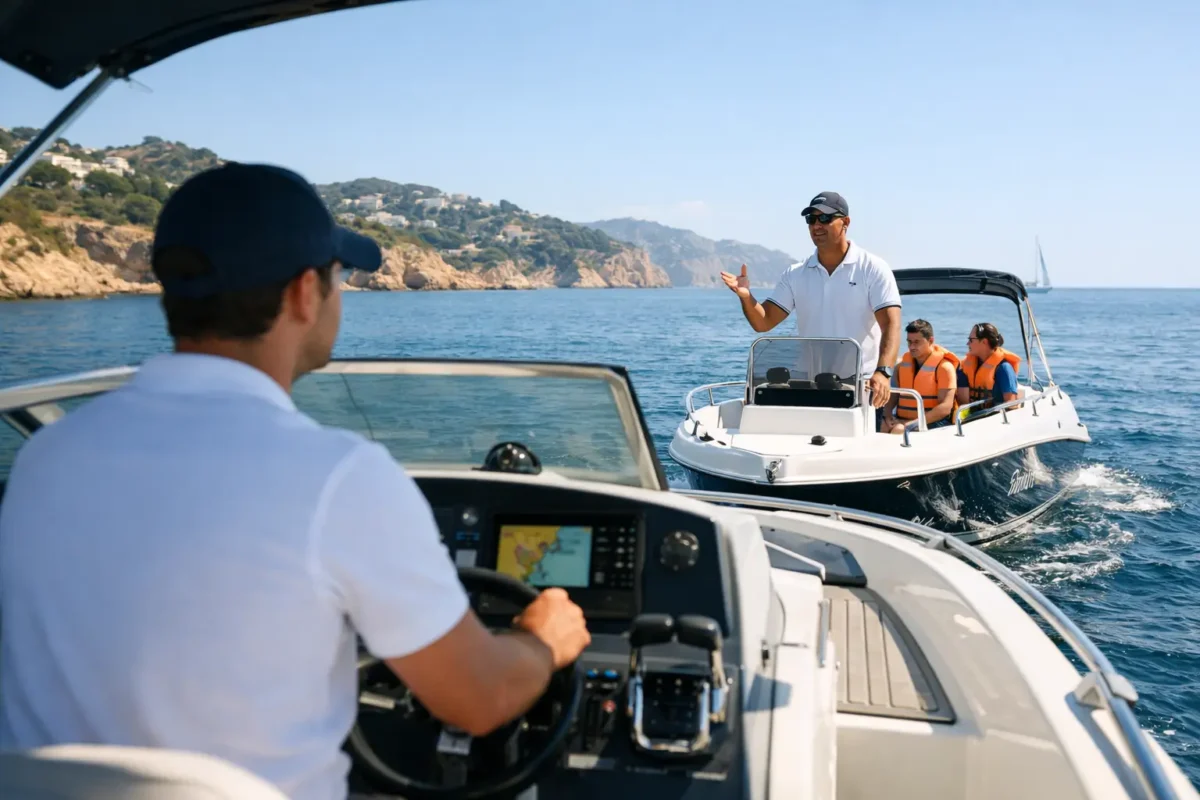
Then comes the part most people remember – practical time on the water. This is where confidence starts to replace nerves. You learn how the boat responds, how to manoeuvre, how to approach simple situations calmly and how to behave like someone who belongs at the helm.
A good school does more than tick a legal box. It teaches in a way that makes you feel sharper, safer and genuinely prepared. That matters because a rushed course can still leave students hesitant afterwards. The qualification is important, but usable confidence is what turns it into freedom.
Is it difficult?
Usually, no. For most adults, the licence navigation course Spain is one of the most accessible official boating qualifications available.
That does not mean it should be taken lightly. The sea rewards confidence, but not overconfidence. Even short coastal boating involves judgement, weather awareness, courtesy, safety habits and basic decision-making. The course is manageable, but it still deserves your full attention.
The reassuring part is that you do not need a nautical background to begin. You do not need to have grown up around boats. You do not need to speak like a seasoned skipper. You simply need the willingness to learn and the sense to respect the water from day one.
How long does it take?
One reason this qualification is so appealing is speed. Compared with more advanced nautical titles in Spain, the process is relatively quick. Many students choose it precisely because they want a realistic route from interest to action without dragging the experience out.
That said, speed should not be confused with carelessness. The best training providers balance efficiency with proper instruction. If a course sounds too rushed to leave you feeling secure, that matters. Saving time is useful. Feeling uncertain once you are alone on the water is not.
For most people, the ideal setup is simple: clear scheduling, practical instruction, no unnecessary complications and an experience that leaves you ready to use the qualification soon after completing it.
How much does a licence navigation course in Spain cost?
Prices vary by school, location and what is included. Some centres focus on the minimum legal requirement. Others build a better student experience around modern boats, stronger instruction, smoother administration and local expertise. The cheapest option is not always the best value if it leaves you with weak practical confidence or unclear next steps.
When comparing providers, look beyond headline price. Check what is actually included, how the practical session is run, whether the school has real operational experience on the water, and whether the process feels clear from the first enquiry. A boating course should feel professional before you ever step on board.
This is especially important in coastal hubs such as Valencia, where choice is wider and standards can vary. An established operator with real sea experience, a strong training structure and the ability to support you beyond the course often makes the whole journey smoother.
Choosing the right school for your licence navigation course Spain
Not every school teaches with the same energy or the same standards. Some are transactional. Others make you feel part of the nautical world from the beginning.
The difference shows up quickly. Good instructors explain without making beginners feel foolish. Good practical sessions feel focused, not improvised. Good operators understand that first-time students are not just buying a certificate – they are buying confidence, clarity and a sense that this new chapter is genuinely within reach.
If you plan to keep boating after the course, choosing a provider with wider nautical services can also help. Training, practical sessions, later upgrades, charter options and administrative support all become easier when you are dealing with a team that understands the full picture. That 360-degree approach is one reason many students prefer established specialists such as Alfa Náutica.
What comes after the course?
That depends on how quickly the sea gets hold of you.
Some people take the qualification, enjoy occasional coastal outings and that is exactly enough. Others discover that one day on the water becomes every free weekend. They start looking at larger boats, longer routes, night navigation and the next title up.
Both paths are valid. The point of this course is not to impress anyone. It is to start. It gives you a legal, practical and exciting way to turn interest into action without overcomplicating the process.
If you have been waiting for the perfect moment to begin, this is usually it. Not when you know everything. Not when you have years of experience. Just when you are ready to stop watching the boats go by and take your place on the water.